


WILDLIFE OF THE ARCTIC
The Eider Ducks
Who is the "Common Eider"?
The common eider (Somateria mollissima) is a large diving duck that is distributed over the northern coasts of Europe, North America and eastern Siberia. On Svalbard, the eiders belong to the subspecies Somateria mollissima borealis.
Every spring, large flocks of eider ducks arrive on Svalbard looking for the perfect place to establish their nest. Here, the males will escort the females around the premises until they have selected a fitting spot. This is usually close to the sea as the ducklings will go straight from their nests into the ice-cold Arctic Ocean surrounding Svalbard.

Nesting on Svalbard
They mostly prefer to nest on islands and very close to each other as a protection strategy from predators who are out for eggs and ducklings. Some will even lay their eggs into cracks between big rocks so that no other animals will be able to find them.
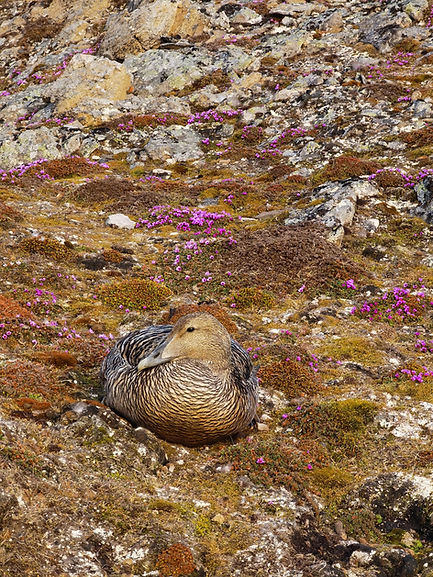
After having established their nests, only female eiders will be left on land to protect and warm the eggs. The female eider only leaves the nest once a day to drink — she will not eat anything for the whole nesting period and lose up to 40% of her body weight.
This is where the eiderdown plays a big role in keeping the eggs warm, protected and hidden at all times. Shortly after they have hatched, mother duck and her ducklings will move straight into the ocean and start to find food for their marine diet.
Predators & Challenges
Eider ducks on Svalbard have many enemies — a polar bear that can destroy many hundred nests in just one hour, skuas and glaucous gulls with their relentless pursuit of both eggs and ducklings and Arctic foxes who are extremely smart egg thieves.
Also the weather conditions can be quite challenging with wind, cold, rain and even snow. These factors result in the female eider only leaving the nest once a day to drink — she will not eat anything for the whole nesting period and lose up to 40% of her body weight.
The highest age of a common eider recorded in Norway (incl. Svalbard) is 58 years and many of them come back to the same nesting place year after year. With an estimate of 13,500 to 27,500 pairs of breeding common eiders on Svalbard, around 4,000 of them come to our eider island "Eholmen" every year.
The Gentle and Resilient Wild Duck
The eider ducks are extremely resilient, selfless, gentle and kind birds. We as humans have a lot to learn from them and it is a privilege to be able to study them closely. We always say that the world would be a better place if we all behaved like the eiders.
The females will selflessly adopt eggs or ducklings left behind in other nests. Both younger female birds (called "aunts") who are not sexually mature yet and mature females without offspring will come on land and sit in groups around an eider that has hatched eggs.
When the ducklings are dry and ready to start their next chapter in the ocean, they will all escort mother and ducklings out into the water and stay by their side as a protection against predators. Their gentle sounds are one of the most calming ones you will ever hear.

The Human-Bird Symbiosis
For centuries, humans in coastal northern regions have been living in a kind of symbiosis with eider ducks. Even though this sort of life is slowly becoming less common in Norway, there are still places in the world where the tradition lives on.
The birds on Eholmen have been looked after for 40 years and we hope it will continue with us far into the future. Even though the eiders are wild birds and quite shy to begin with, they get accustomed to our presence as their guardians and stay calm when we walk around the island. They are however very sensitive to change so even some different clothes or
new people can make them leave their nests for good. This is why Eholmen is an officially protected area during the nesting period and the two of us are the only people allowed on
the island.
— Tommy & Lisa, Svalbard Fangst
The protection that derives from us is vital to the ducks' breeding success. In return, we get to collect the down from their nests that they will not need anymore once the ducklings have hatched. If not collected, the eiderdown would be blown away by the wind or damaged by rain. This symbiosis happens in a sustainable, respectful and ethical way.
Why do they come back every year?
Having learned that there is a higher breeding success when nesting on our island protected by humans, the same eider ducks will come back to Eholmen year after year. With them, they also bring other birds that have not been there before.
When eider ducks see many other birds of the same species nesting in a place, they automatically assume that it must be a relatively safe environment which makes them come on land there as well. Having however not been successful one year, some birds might not return to the island again. This is strongly dependent on predation and explains the fluctuating numbers of birds from year to year.

Eholmen — The Biggest Eider Colony in Norway
With approximately 4,000 birds each year, our colony on Eholmen is the largest actively tended eider colony in both Norway and Svalbard.