


LIFE IN THE ARCTIC
Our Story
Who is behind "Svalbard Fangst"?
We are Tommy and Lisa, and together we live as full-time trappers on an island in the archipelago of Svalbard. Our year consists of different periods and in the whole of June and July, we take care of our eider duck colony. We are a two-person-operation so it is quite intense to take care of the currently biggest eider-colony in Norway.
Even though that time of the year is very demanding, it is so giving to live with and learn from these incredibly gentle and kind birds — it is definitely a privilege for us to be able to live like this. We are focused on traditional hunting and trapping, local products, animal welfare and sustainability.


Trappers of Svalbard
Tommy Sandal has been hunting and trapping since he was a little boy living in Røldal, Norway. He has been trapping for a living since 2007, with his first overwintering in 2003. After a few years in the North of Svalbard, he took over the trapping area and cabins in Bellsund in 2011.
The first time he came to Eholmen (our eider colony) was in 2007 when he was helping the previous trapper Louis Nielsen with the down season. He was instantly fascinated by the eider ducks and the symbiosis between human, nature and birds. Tommy is very focused on protecting the environment and conserving Svalbard as a wilderness.
Lisa-Marie Seidl is originally from the Alps, but has been living on Svalbard and in Northern Scandinavia for many years. Working as a journalist and dogsledding guide, she had never hunted or trapped before coming to Svalbard. The first time she came to the trapping area in Bellsund, she instantly felt like this was the most special and beautiful place in the world - surrounded by nothing but nature and animals. She became a part of Svalbard Fangst full-time and has not looked back since. Luxury for her these days is watching the rich animal and bird life, marveling at the landscape turning from lush to frozen and lighting a fire in one of their small off-grid cabins. This makes us understand better what we are trying to protect and conserve.
A Family Tradition
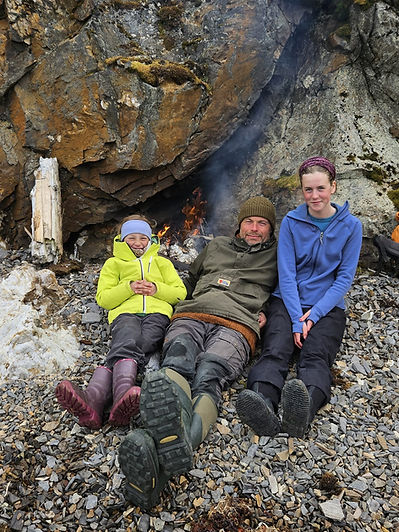
Our family members have helped us a lot over the years and we are incredibly thankful for that. Tommy's children, Anna Marie and Åsne Solea have both grown up hunting, fishing, trapping and collecting down on Svalbard. Even though they now live on the mainland, we appreciate it every time they come to Svalbard during their school holidays and help out with everything that comes along.
Where exactly does the down come from?
All of the eiderdown that goes into our duvets is harvested by hand by us on Svalbard. Most of it comes from our main colony on Eholmen, "the eider island".
There are some other islands in our trapping area Bellsund that we harvest down from. Most of the birds are however concentrated on Eholmen since they feel more protected there.
After an intense period there, we usually travel to the North of Svalbard by boat and collect down from several islands in Kongsfjorden after the eiders have hatched. Since these islands are part of a bird sanctuary, we are in close contact with the local scientists and report back any observations we make.

The History of Eholmen
"E" means "eider" while "holmen" translates to "island" — this suggests that there have been eider ducks nesting on Eholmen for a long time.
When the first hunters arrived in Svalbard (in 1600/1700), they unfortunately engaged in predatory hunting without consideration for the birds. The common eider first got protected on Svalbard in 1963. Even today, we still find empty shells on the island, indicating that trappers, fishermen, hunters, and others ruthlessly hunted the eider ducks.
In 1982, former trapper Louis Nielsen began collecting down from the eider ducks on Eholmen. From 1986 until 2010, he regularly tended the birds and collected their down on the island. Due to a certain degree of protection for the eiders, the population increased from 600 pairs in 1986 to 4,700 pairs in 2007.
In 2011, Tommy took over the colony on Eholmen and has looked after the island every year since.
What do our lives look like year-round?
The eiderdown process spans over several parts of the year.
Summer
The whole of June and July, we are busy protecting the birds and harvesting the down. In the summer, there are 24 hours of sunlight on Svalbard and we dive right into our eiderdown season. While we air-dry the down instantly as we go along (which is very important for quality protection), many parts of the long cleaning process happen later.
Winter
During winter, there is complete darkness on Svalbard. This is the time for traditional trapping of Arctic foxes. When the weather is bad (we do get a lot of snowstorms here, especially in December and January), our time is used for further cleaning eiderdown, sewing our exclusive eiderdown duvets and skin preparations.
Autumn
Autumn is the busiest time for reindeer, goose, seal and grouse hunting. Drift wood for the winter and fox traps for Arctic foxes are being prepared. When the days start getting darker, we start to machine clean our eider down in the long evenings (a strenuous and long process).
Spring
The spring is a period for mating, reproduction and new life — it is important to give the species peace and quiet. We therefore have time for sewing more duvets and handmaking other products, before the cycle begins anew.
