


NATURE'S FINEST INSULATOR
Eiderdown
What is Eiderdown?
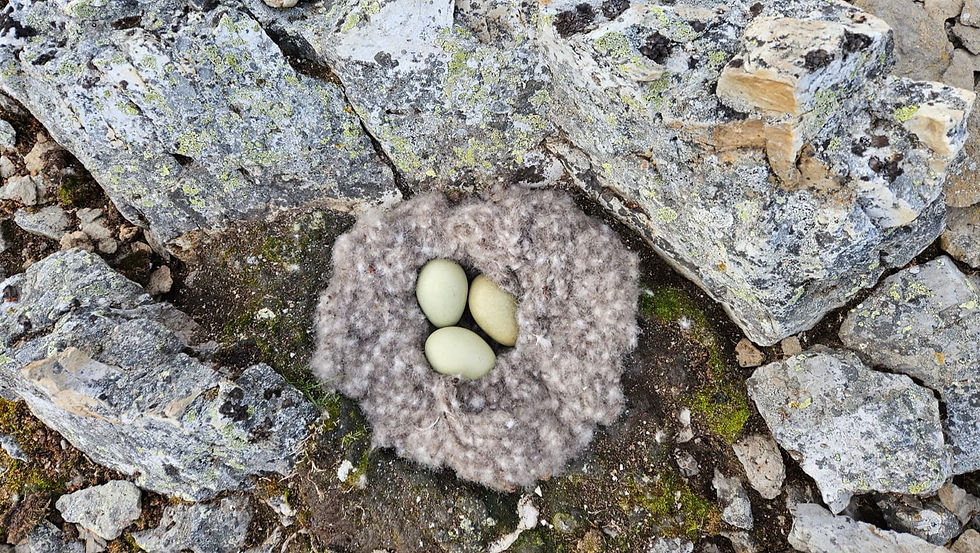
Eiderdown refers to the very soft, insulating and incomparably warm down coming from the wild bird called "common eider". It is a fluffy and lightweight layer found beneath the exterior feathers of the female eider duck.
While living at sea their whole lives, these seaducks come on land only to nest. This is when the female's body temperature begins to rise and she sheds the down layer naturally in order to line her nest with it. By that, she guarantees that her eggs are well insulated and kept warm in any kind of weather conditions.
What makes it so special?

Unparalleled Warmth
Eiderdown is unparalleled in its lightweight, soft and warm natural properties, which makes it the most valuable down in the world.

100% Down, No Feathers
Eiderdown is the only down in the world that comes with absolutely no feathers or quills which means that all of our eiderdown duvets are filled with 100% pure down.

Microscopic Hook Structure
It is remarkably cohesive due to millions of microscopic "hooks" which make it cling to the fabric of your duvet as well as to itself. This makes it stay perfectly in place while avoiding cold spots inside the casing.
.png)
Built for Generations
Its natural layer of oil makes it incredibly flexible, water-repellent and durable. An eiderdown duvet can last many generations if properly taken care of.

Why do we call it "organic"?
What sets eiderdown apart are not just its insulating and lightweight properties, but the unique way under which it is harvested. All of our down is exclusively harvested by hand by us in a respectful and gentle way.
The eiders come back to our island voluntarily each year as we try to protect them against predators which increases their chances of a successful nesting and hatching period. In return, we get to collect the down that is no longer needed by them. This symbiosis seems to have worked well for both animals and humans for many hundred years.
At no point in the later cleaning- and warming-process does the eiderdown come in contact with any chemicals — we like to keep it nature-friendly from the beginning until your duvet arrives at your home address.


What is the difference to goose down?
Holding up a ball of eiderdown, you will see that nothing falls off. This is due to eiderdown not having a quill shaft but rather a fixed central point from which the barbs spread outwards. Small "hooks" at the end of the barbs make the down stick together unlike any other kind of down.
Eiderdown is harvested from the nests of the wild eider duck, whereas other down mostly comes from farm-raised birds. If you have owned for example a goose down jacket or sleeping bag before, you would have seen little feathers coming out through the fabric once in a while.
As opposed to other types of down, eiderdown contains 0% feathers and 100% down. This means that there is no wear and tear of the down filaments caused by the shaft of feathers which leads to unparalleled durability and softness of the material. Eiderdown will keep its structure and softness over time, while also being more lightweight due to the absence of feathers.

History of eiderdown in Norway and Svalbard
Eiderdown collection has a long-standing history which began in the 9th century with Norse settlers in Iceland beginning to tend nest sites. The down soon became valuable in trade (especially in the Viking era), used as tributes and gifts to the European royalty due to its unique insulating properties. It would become a symbol of status and wealth in medieval Europe and in the centuries to come.
In Norway, some of the oldest finds of eiderdown include bedding found on the Oseberg Ship from 834 AD. When archeologist unearthed this burial site in 1904, they discovered around 31 kilos of eiderdown sewn into duvets used by the high-standing ladies onboard, suggesting that even back then eiderdown bedding was reserved as a rare luxury good.
In the 18th century, the down was so well priced in Norway that it was used to pay taxes to landowners. On islands along the coast of Norway, especially Helgelandskysten, eider protection and down collection has been a tradition for many hundred years. There, people would build shelters for the ducks to nest in, set up fences to keep out predators and build up a relationship that is similar to that with domestic animals. Today, the islands of Vega and their eider tradition has UNESCO World Heritage status.
On Svalbard however, the custom of eiderdown collecting had a whole different side to it. Until 1925 (when Svalbard officially became Norwegian), the archipelago was "no-man's-land" and without any official rules at play, hunters, trappers and others had been exploiting the eiders mostly for their eggs and down. This "free-for-all" collection lead to a dramatic decline of the eider population on Svalbard. Protected by legislation in 1963 and helped by the establishment of several bird sanctuaries in 1973, the eiders have slowly been recovering. Today, we are looking after the only eider colony actively tended by humans on Svalbard, where extreme weather conditions and heavy predation make it a ceaseless struggle to look after the birds. Nonetheless, it is our greatest joy and privilege to look after the biggest eider colony in both Norway and Svalbard, with a number of around 4.000 birds each year.
